READ THE FULL ARTICLE IN RETAIL JEWELLER’S MARCH 2024 ISSUE
With confusion around what ‘recycled’ means in the context of jewellery production, May Garland engages with industry experts to unravel common misconceptions surrounding the term
To recycle or not to recycle? With brands now more than ever shouting about their use of recycled precious metal in jewellery manufacturing, the consumer can be left questioning what this term truly means and how ethical this resource is.
Businesses such as Danish jewellery giant Pandora have fully embraced recycled precious metal. The company announced in January that it has shifted its entire production to use only recycled silver and gold, a move it says avoids 58,000 tonnes of CO2 emissions from being released into the atmosphere each year.
Also considering its sustainable strategy is British casting specialist and fine jewellery manufacturer Hockley Mint, which has offered wedding rings made from recycled precious metals as standard since November 2022. Likewise, popular brands such as Missoma, Georg Jensen and Matilde have also launched recycled precious metal collections. But despite the rise in popularity of recycled metals in recent years, it’s not always clear what the notion of recycling means in the context of the jewellery industry.
As with so many issues surrounding sustainability in the jewellery trade, the answer is far from straightforward. Eponymous bespoke jeweller and author of her own blog post discussing the subject, Harriet Kelsall, notes that there is currently not formally accepted definition for ‘recycled’ when it comes to jewellery. “In today’s ethically conscious world, one word is not enough and as a result it is being misused, thus misleading people,” she explains.
In Kelsall’s blog post ‘How to make the right ethical choice for your gold engagement ring’, she explains that “large-scale consumer waste gold is not a thing. It doesn’t get thrown away. Recycling isn’t ‘saving’ everyday gold from going into landfill or out into the ocean, like with plastic.”
Recycling in the context of the jewellery trade isn’t necessarily the same as the sort of recycling consumers might be familiar with, such as taking an old plastic bottle and turning it into a bag. Consumers demonstrated these misconceptions when Retail Jeweller posed the question, “What does ‘recycled’ in this context mean to you?” in our Consumer Sustainability Research (see page 22), offering responses such as “made from second-hand materials” and “old broken jewellery melted down”. With the absence of a formally accepted definition, customers are left to create their own ideas on what the term means.
The Betts Group managing director and founder of Single Mine Origin (SMO) gold Charlie Betts agrees that consumers may not be digging deeply into recycling claims. “[It’s] a label that is very easy to use, which also has a clear effect on consumers. I think it is our responsibility as an industry to educate consumers and to make sure that labelling jewellery as recycled actually means something,” he says.
What to look for…
“Within recycled gold, jewellers need to look for products offering ‘known provenance recycling’ meaning there is a clear chain of custody (eg. to recycled post-consumer electronics). For artisanally sourced gold, consumers need to ensure it is sourced through an organisation reducing the risk of dangerous environmental or human rights risks (such as Fairtrade or Fairmined) and, within large-scale mining, Single Mine Origin ensures that gold can be traced to a specific mine, operating to independently audited responsibility standards.” Charlie Betts Managing director, the Betts Group
When considering a more meaningful label for recycled precious metal, Kelsall points out that “reusing gold is, and has always been, the status quo of jewellery production”. She continues: “One of gold’s fascinating attributes is that it’s easily melted down and refined, looking as good as new. Recycling is an obvious option – it’s a straightforward process that makes financial sense.
As she explains, the ‘recycled’ label can be deceiving. “The bullion that is sold to jewellers as ‘recycled’ is rarely consumer waste, which is what most consumers and some goldsmiths would assume,” she says. “In fact, the vast majority of it is waste from industrial processes used in the jewellery industry, which would have originated from large-scale industrial mines.”
Presman Mastermelt’s general manager Gary Williams adds to Kelsall’s point by saying “it is very difficult to ascertain whether a gold bullion bar is made purely of recycled gold” unless there is a very clear and detailed supply chain provenance. This is why companies such as Mastermelt aim to provide clarity for jewellers. Its reclaimed, processed and recycled gold has been “purchased from jewellery and pawnbroking businesses across the UK, in the form of caratage jewellery, manufacturing off cuts, lemels and sweeps,” explains Williams.
The Betts Group also works with recycled gold, recovering precious metals from all types of waste, such as that generated by the jewellery, ceramic, photographic, industrial and dental professions. Companies such as 886 by The Royal Mint and The Rock Hound have sourced from Betts Metals, using material such as silver extracted from old X-ray film.
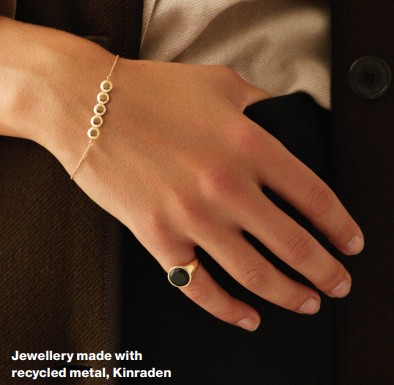
“For Kinraden, recycled metal isn’t just a choice – it’s a dedication to eco-conscious practices” Sarah Müllertz Kinraden
Using e-waste and medical waste is a good example of where recycled precious metal can be measured and examined, while also aligning with the more widely understood idea of recycling that the consumer has in their mind of reusing waste materials. Sarah Müllertz, founder of Copenhagen-based jewellery brand Kinraden, passionately believes in the importance of recycling in the jewellery industry, using reclaimed healthcare and technology equipment in its jewellery production. “For Kinraden, recycled metal isn’t just a choice – it’s a dedication to eco-conscious practices. Beyond reducing the environmental impact of traditional mining, it champions the circular economy, breathing new life into existing materials,” she says.
Betts clarifies that recycled precious metal can be considered an eco-conscious practice “if it is coming from a source that was previously going to waste”. He continues, “If a jeweller is simply buying metal that has been re-alloyed, or even metal from scrap jewellery, I see very little to shout about… They are simply doing what has been done for centuries but shouting about it a lot more.
There are, of course, benefits to recycling precious metal, such as reducing mining exploitation and the impact of this on the environment. Adam Hunter, commercial director of jewellery supplier Cooksongold, explains that “extracting metals and refining them requires a substantial amount of energy. By using recycled precious metals, the demand for new mining is decreased, helping to preserve the environment.
When it comes to using recycled metal, the larger question is: does it really make a difference? Betts comments: “By using recycled metal, a jeweller can have a micro-level sustainability gain, but at a macro level, they are simply taking a slice of an existing pie. The mined material of today is the recycled material of tomorrow, so, at a macro level, a greater impact can be achieved by focusing on reducing carbon emissions from mining via fleet electrification, solar arrays and other measures.”
The jewellery industry is already close to a “perfect market”, he notes, in terms of recycling within the trade and low levels of discarded or ‘wasted’ precious metal. And while this may be somewhat reassuring, there is clearly scepticism and confusion among customers that can’t be ignored. This was particularly evident in the results of Retail Jeweller’s Consumer Sustainability Research, where 51.7% said they would ‘very likely’ purchase a piece of jewellery described as being made from ‘recycled precious metal’ versus just ‘precious metal’ if there was no price difference, while 48.3% opted for ‘not likely’. This is a surprising contrast to the results from the same survey in 2023 when 87.5% of consumers said they considered jewellery made from recycled precious metal to be “a good thing”.
So, what’s changed? It is difficult to ascertain whether this shift points to an issue with the definition of ‘recycled’ precious metal or the luxury shopper viewing ‘recycled’ as having a diminished value.
For Aisling Connaughton, co-founder of sustainability consultancy Cyd Connects, the results suggest the latter. “Often in luxury sectors, people don’t like the idea of a product coming from waste,” she says. “So, the results may suggest consumers want ‘new gold’ rather than ‘old gold’. It’s a case of changing this psychology and educating brands and consumers on this.” Connaughton adds that “the great thing about precious metals is that it doesn’t matter how many times we melt them down, they can be used again and again. They are infinitely recyclable.”
Providing this education to consumers is vital but challenging for retailers, who are competing with the surplus of misinformation and greenwashing. Independents taking part in our retailer survey (page 33) said they believe that customers are confused and misinformed (40.4%) or that they occasionally need guidance and information (59.6%) about the sustainable and/or ethical credentials of key materials, such as laboratory-grown diamonds, precious metals and gemstones.
Kelsall calls out businesses that are using sustainable terms as tools for false advertising. “Many companies are shouting about how their dealing with recycled gold is ‘saving the planet’ and using it as a huge selling point,” she says. “It’s all helpful, of course, which we are huge advocates for, but what we struggle with is how it is being presented.
She admits that while this greenwashing may not be deliberate, it still exists. “We know that some are aware of their greenwashing, but there are also jewellers and goldsmiths who make the same assumptions as consumers, without delving into the processes. It’s an oversight that results in unintentional greenwashing,” she says.
The solution to end this confusion? The industry needs clarity and transparency for the customer. As Kelsall suggests, “The more jewellers who spread the word, the truer information is shared, and hopefully, appropriate changes are made to recognise the true understanding of the term.”
There is no formal, clear definition for recycled precious metals to draw on at the moment. However, John Mulligan, president of the World Jewellery Confederation’s (CIBJO) Sustainable Development Commission and climate change lead and market relations director of the World Gold Council, hints at promising developments. “There are current efforts in progress by industry bodies and international standards organisations to try to arrive at an agreed or broadly aligned definition [of ‘recycled’ in the context of precious metals], and both the World Gold Council and CIBJO are very much supportive of and active in those endeavours,” he says.
Retail Jeweller has also been informed that the National Association of Jewellers (NAJ) is working on its own Code of Practice for green claims to be released later this year with a section dedicated to recycled gold. Once a clear definition is decided upon, this information can be shared with the wider trade and consumers. But for now, the jewellery industry needs to dig deeper into claims of sustainability to prevent the spread of misinformation about recycled precious metals and other ‘ethical’ terms to make this a more transparent industry.
 May Garland