READ THE FULL ARTICLE IN RETAIL JEWELLER’S MARCH ISSUE
Leading on from the Copenhagen Commitment and Goldsmiths’ Centre’s traceability debate, May Garland asks the jewellery industry how businesses can become more sustainable and if full transparency is possible.
The transparency debate held at the Goldsmiths’ Centre on 7 and 8 November last year, and chaired by Copenhagen Commitment co-founder, brand strategist and change management consultant Camilla Frederiksen, has sparked an ongoing discussion in the jewellery industry as to whether transparency and collaboration is the way forward.
The speakers over the two evenings included Copenhagen Commitment co-founder and activist for the rights of artisanal miners Yianni Melas; Ocean Diamonds creative director Elly Buck; Inonge Zita Jewellery creative director Patricia Inonge Mweene; Maria Black Jewellery founder Maria Black; EC One founder and managing director Jos Skeates; Wennick–Lefèvre founder and Copenhagen Commitment co-founder Svend Wennick; and executive director of the Watch & Jewellery Initiative 2030 Iris Van der Veken.
The discussion on 7 November took on the complex topic ‘Why transparency and what is a responsible business?’ It considered the collaborative nature of the jewellery industry, with jewellers reliant on the efforts of the people they work with throughout their supply chain, asking what made it so difficult to navigate when trying to work more ethically and sustainably, and the levels of transparency that are required to achieve this.
The debate highlighted key points such as the lack of education and information made available to brands on how to make their business more sustainable, the controversial debate of recycled gold versus Fairmined or Fairtrade gold, and what defines a transparent business model.
During the debate, Maria Black suggested that the industry’s priority should be giving back to the indigenous communities where its materials were taken from. “Responsible sourcing means giving back to the indigenous mining communities, the people who live and breathe in that earth who had these resources to begin with,” she said.
Black explores how integral artisanal miners are to the jewellery industry in her report titled ‘Framework for Maria Black Jewellery Sourcing Strategy,’ which states that “the artisanal and small-scale miner group (ASM) makes up about 90% of the gold industry’s total workforce […] while generating only around 17% to 20% of the total gold mined annually.”
Foundations such as Fairtrade focus on improving lives and bettering the environment in ASM producer communities. The Fairtrade certificate also ensures a minimum standard of operation that requires artisanal miners to possess permits and ban children from the mining site among many other things. “In return, the miners are paid 95% of the international gold price plus a social premium that the miners invest in their communities. Gold sourced in this way is also fully traceable,” explains Black.
The panel agreed that artisanal miners have been wrongly demonised. Yianni Melas reminded the panel that artisanal mining is a way of life for indigenous communities, who often work in remote conditions with little access to safety equipment and healthcare, and without the proper channels to sell their gold, which leaves the door open for exploitation. He encourages jewellers, if they are able, to take a trip to communities in countries such as Zambia to offer their support and teach their craft.
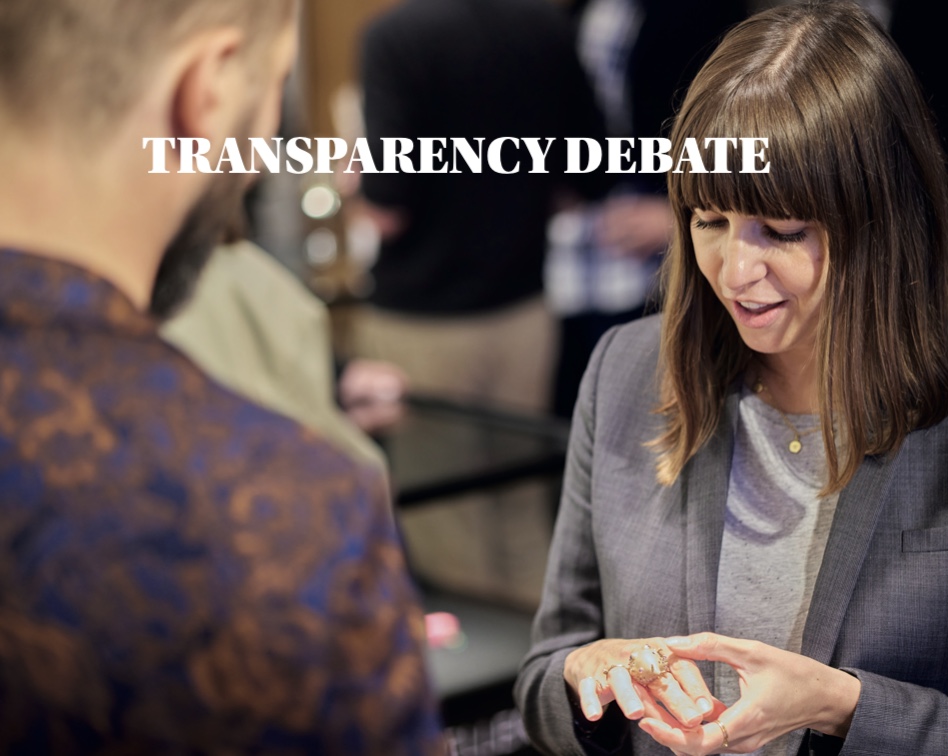
The panel discussion followed on from a transparency pop-up exhibition earlier that day, where jewellers showcased their ethically made collections. Shimell and Madden, Shivani Chorwadia, Max Danger, Roc Majoral, EC One, Alex Monroe, India Mahon and Ana Verdun were among the jewellers exhibiting. The pop-up provided an opportunity for brands to connect and share ideas – something that speakers at the debate deemed essential for industry progress. “We hoped that this event would bring the jewellery community together in an honest and open way, creating a non-judgmental space where we can freely challenge our preconceived ideas of responsible jewellery,” said head of fine jewellery at Alex Monroe Susie Ekelund.
WHAT SHOULD TRUE TRANSPARENCY LOOK LIKE?
Leading on from the event, Retail Jeweller continued the discussion on sustainability by asking members of the jewellery industry: “Is it possible for the jewellery trade to be truly transparent in its practices?”
India Mahon, founder of her own ethical jewellery brand, which showcased at the transparency pop-up exhibition, kickstarted our discussion. “It’s important that we share the ethical traceability (both human and planet) of the precious metals and gemstones used to create each piece of jewellery with our customers. I start all my customer conversations with the importance of transparency and ethics,” she says.
Jeweller and founder of Aymer Maria Ruth Aymer also highlights the importance of traceability when talking to customers. “Transparency in the jewellery trade requires traceability across the entire supply chain, focusing on fair treatment of all people along the way. It is the responsibility of jewellery companies to commit to ethical and sustainable practices. Aymer Maria strives to achieve this by working with supply chain partners close to the source. For example, we work with ethical mines in Botswana, where we source our precious stones, and foundries in Spain that only smelt recycled metals, ensuring the materials used to create our pieces have an origin story we can share with our clients,” she explains.
Managing director of precious metal casting company Weston Beamor Andrew Morton argues that making the jewellery trade truly transparent is possible. “We have developed policies and procedures to ensure all three [of our] companies – Domino Jewellery, Gecko Jewellery and Weston Beamor – provide a transparent service that our retailers and their consumers can trust,” he says.
“Alongside our own internal auditing policies, as an accredited member we are also audited by the Responsible Jewellery Council, ensuring we are following ethical and sustainable practices from start to finish of our supply chain. We work with our suppliers to ensure we have complete transparency of our materials from stone sourcing to the purchasing of ethical packaging, ensuring we provide our retailers with assurance.”
Manufacturer Hockley Mint’s managing director Gary Wroe looks optimistically at the future of sustainability in the jewellery industry, but suggests there is more work to be done by all businesses. “Some organisations within the jewellery trade have made great strides towards transparency, changing the way they operate to exhibit how business should be conducted with honesty and integrity,” he says. “These are vital traits in our industry and the foundations on which strong relationships are built, both with suppliers and customers. If the jewellery sector commits to a truly transparent mindset, I know it would be possible. Unfortunately, different organisations have different motivations and goals, making it highly unlikely that the trade will have a fully transparent supply chain. With the right mindset, anything is possible. Let’s hope we can come together for the good of our industry.”
Sarah Müllertz, founder of handmade fine jewellery brand Kinraden, believes in sharing resources and information with her industry peers. “At Kinraden, we are advocates for the open sourcing of ethical materials within the jewellery industry. Open sourcing of ethical materials can play a positive role in jewellery production and, in turn, the environment. Brands rarely share this information with their peers for fear of limiting resources. However, we believe the future is created with available resources, and we are happy to share this information with our potential competition.”
Animal-inspired fine jeweller Clio Saskia claims that from her observations levels of transparency are dependent on whether you are a large- or small-scale business. “For a mass-made jewellery company, there are so many moving parts that it can be an enormous challenge to be fully transparent, whereas if you are a small, independent handmade jewellery business, it is much easier to track all aspects of your operation,” she says. “It’s relatively easy in the modern day to find suppliers who offer traceable gemstones or recycled gold, for example, and I believe smaller jewellery businesses should be aware of where their raw materials are coming from in order to offer full transparency to their clients.”
F.Hinds diamond buyer and company director Andrew Hinds thinks the jewellery industry needs to work together. “Every industry has challenges with transparency given that there is always a valid reason for not wanting to provide details of one’s supply chain. Supplier relationships are central to every business’s competitive advantage. I believe this is why we need to work as an industry to make it possible for everyone to meet high standards in all areas, including sustainability, so that businesses will be able to warrant that their entire supply chains meet these standards without needing to disclose their individual suppliers if they don’t want to.”
Lebrusan Studio founder Arabel Lebrusan believes customers are the primary factor for enacting industry change. “In the chaotic world in which we live, our customers simply want clarity,” she says. “I know that a fair and transparent jewellery trade is possible – it’s simply a case of us working together and ensuring that the step for which we are each responsible is simple and clear. This will enable us to tell beautiful stories alongside the beautiful jewels we sell, satisfying our customers’ right to the truth and offering them a product to feel truly proud of.”
National Association of Jewellers (NAJ) compliance and policy manager Katie Gillespie comments: “In short, the jewellery trade can be transparent, but it will take significant support. This year, the NAJ will release a new sustainability code of practice to help our members with this question and act more responsibly. There are so many touch points throughout the supply chain that for genuine transparency to occur, we require commitment from every stakeholder. Difficult? Undoubtedly. But a crucial step for our industry.”
Charles Odoom, co-founder of the Jewellery and Gemstone Association of Africa (JGAA), where he is lead on research, development and business advisory, and head of private sector development at the African Center for Economic Transformation (ACET), closes our debate. “Transparency within the industry will require a strong commitment to traceability requirements and a stricter ESG adherence by all players,” he concludes. “The jewellery industry should widely adopt traceability tools such as blockchain and other technology-enabled processes in the value chain to build confidence and ensure more socially and environmentally responsible practices. Progress is being made globally and we believe that new business models within the industry will soon adopt and drive a more cohesive transparent agenda for development, including the emerging African jewellery industry.”
The consensus of the debate is that transparency is possible and there is room for the jewellery industry to improve. There is no straightforward path to making the jewellery industry more sustainable; instead, a collaborative effort must be encouraged between jewellery businesses. Conversations between jewellers on ways to give back to indigenous communities, sharing connections and innovative ideas on making supply chains more transparent, are key to making the jewellery trade of the future a more ethical and responsible place.
 May Garland